


Nicotine withdrawal typically begins within a few hours of your last cigarette or vape, peaks around the first 3 days, and most physical symptoms ease within 3 to 4 weeks. Psychological cravings can still surface months later, often triggered by familiar routines or stress. We built this guide to walk you through each stage, and we’ll show you where a nicotine-free ritual, like the blends we make at Nature of Spirit, can fit into that process.
TL;DR:
- Combining counseling or digital support with recommended medication, such as nicotine replacement therapy or prescription treatment, works better than relying on willpower alone.
- A patch provides steady nicotine, while gum or lozenges address sudden cravings; ask a pharmacist or doctor to match doses to your smoking history.
- Later cravings often reflect learned cues, not ongoing physical dependence; track triggers for a week or two and plan a response for stressful moments.
- Seek immediate professional help for severe or persistent depression, thoughts of harming yourself, confusion, or hallucinations, rather than managing these symptoms alone.
Table of Contents
- The first 72 hours: why this window feels hardest
- Week 1 to week 12: how symptoms change over time
- What withdrawal symptoms actually feel like, and how long each lasts
- What’s actually happening in your brain and body
- How to manage withdrawal: medication, support, and daily tactics
- When withdrawal symptoms need medical attention
- Setting realistic expectations and clearing up common myths
- How ritual replacement can support your withdrawal process
- Our take on the quitting advice you’ll find everywhere
- A nicotine-free way to keep the ritual going
- FAQ
- Sources
The first 72 hours: why this window feels hardest
Nicotine leaves your bloodstream fast. Within hours of your last puff, nicotine levels drop sharply, and your brain, which has adjusted to regular nicotine exposure, starts signaling that something is missing. This is why withdrawal does not wait politely. The NHS notes that symptoms usually start within a few hours and are strongest during the first 3 days, a pattern echoed by the National Cancer Institute, which describes withdrawal as typically beginning within hours and peaking early before gradually declining.
During day one, you might notice restlessness, a nagging urge to smoke, and a mind that keeps circling back to cigarettes or your vape pen. Mild headaches and irritability often creep in by evening. None of this means anything has gone wrong. It means your body is adjusting to functioning without a chemical it had grown used to.
Day two tends to intensify things. Cravings arrive in sharper waves, often lasting just a few minutes each, but they can feel relentless when they stack up throughout the day. Concentration gets harder. Some people describe a kind of mental fog, as if their thoughts are moving through static. Sleep may already be disrupted, with vivid dreams or trouble falling asleep.
By day three, many people hit the peak the NCI describes: the hardest stretch, where irritability, anxiety, and craving intensity are all working at once. This is also the point where your body has cleared most of the nicotine from its system, so what you are feeling now is less about chemistry and more about your brain recalibrating its reward pathways.
Here is what commonly shows up during these first three days:
- Intense, wave-like cravings that peak and fade within minutes
- Irritability or a short temper over small things
- Anxiety or a restless, on-edge feeling
- Difficulty concentrating or a foggy sense of focus
- Mild headaches, especially in the afternoon or evening
- Trouble falling or staying asleep
Getting through this window comes down to a handful of tactics that work in the moment. When a craving hits, try the delay method: wait briefly and do something else with your hands, since most cravings pass within that window whether or not you act on them. Deep, slow breathing (in for four counts, hold for four, out for six) calms the nervous system enough to blunt the sharpest edge of a craving wave. If you are using nicotine replacement therapy, following the dosing guidance on the product, whether patch, gum, or lozenge, matters more during these first days than at any other point, since this is when your body is asking the loudest for nicotine.
Pro Tip: Keep your hands busy during the first 72 hours. A fidget object, a stress ball, or even a nicotine-free herbal blend you can hold and draw on gives your hands something familiar to do while your brain relearns that a craving does not require a cigarette.
Week 1 to week 12: how symptoms change over time
The first week sets the tone, but it is not the whole story. Physical symptoms generally start softening after day 3 to 7 for many people, even though the early stretch feels like it will never end while you are in it. What follows is a gradual unwinding, not a straight line.
- Week 1: Cravings remain frequent but usually shorter per episode. Sleep is often still disrupted, and appetite tends to increase as your body searches for a replacement reward.
- Weeks 2 to 4: Mood swings become less extreme, though they do not disappear. Sleep typically starts normalizing, and cravings shift from near-constant to more occasional, often tied to specific triggers like stress, alcohol, or a morning coffee.
- Weeks 4 to 12: Physical dependence has largely resolved for most people. Psychological cravings become less frequent but can still appear in response to cues, a certain smell, a social setting, a hard day at work, sometimes catching people off guard months into their quit.
On average, nicotine withdrawal lasts between 2 and 4 weeks, according to clinical review evidence tracking quitters over time, though individual experiences vary widely based on how long and how heavily someone smoked or vaped.
What makes this stretch tricky is the mismatch between what people expect and what actually happens. Many assume withdrawal is a fixed event with a clear endpoint, three days and done, when in reality it is a gradual decline punctuated by occasional spikes. A stressful week at work in month two can trigger a craving as intense as anything felt in week one, even though the underlying physical dependence is long gone by then.
Sleep tends to be one of the slower systems to recover. Nicotine affects sleep architecture, and some people report restless nights well into week three or four before things settle. Appetite changes follow a similar pattern: increased hunger is common early on and tends to fade as the weeks pass, though some people notice a lasting shift in taste or smell sensitivity that they actually enjoy, since nicotine use dulls both senses over time.
The practical takeaway for this stretch is patience paired with pattern recognition. If you know Friday evenings or stressful meetings tend to spike your cravings, you can prepare for them specifically rather than being caught off guard. Journaling triggers for even a week or two reveals patterns that make the remaining weeks far more predictable.
What withdrawal symptoms actually feel like, and how long each lasts
Withdrawal is not one experience. It is a cluster of symptoms, each with its own timing and its own best response. Breaking them apart makes the whole process less overwhelming because you can address what is actually happening instead of just feeling generally bad.
Craving waves are the most recognizable symptom. They typically last only a few minutes at a time but can recur dozens of times a day during the first week, then taper to a handful of times a day by week two or three. Cravings are often tied to specific cues, such as coffee, a drive, a work break, or a drink with friends. Recognizing your personal triggers and either avoiding them temporarily or preparing a response, such as a short walk, a glass of water, or a nicotine-free herbal blend to hold and draw on, may help make them more manageable.
Irritability, anger, and anxiety can be strongest early on and may gradually ease over time. Short-term tactics help here: stepping outside for a few minutes, a brief walk, or simply naming the feeling out loud (“this is withdrawal talking, not me”) creates enough distance to avoid snapping at people you care about.
Sleep disturbance and fatigue can accompany withdrawal and may ease over time. Keeping a consistent bedtime, avoiding caffeine late in the day, and dimming screens before bed all support the sleep hygiene that nicotine withdrawal temporarily disrupts.
Appetite increase and concentration trouble tend to show up together. A rise in appetite is common during the first few weeks as your brain searches for a replacement dopamine hit from food. Keeping easy, satisfying snacks on hand (nuts, fruit, something with texture to chew) helps without derailing other health goals. Concentration problems may ease over time as your brain adjusts.
- Craving waves: minutes at a time, frequent in week 1, occasional by week 3
- Irritability and anxiety: strongest in week 1, easing over 2 to 3 weeks
- Sleep disruption: common for 2 to 3 weeks, sometimes longer
- Appetite changes: most noticeable in the first few weeks, often settling by month two
What’s actually happening in your brain and body
Nicotine binds to receptors in your brain that normally respond to acetylcholine, and with regular use, your brain grows more of these receptors to compensate for the constant nicotine exposure. When you quit, those receptors are suddenly overstimulated, and that mismatch between what your brain expects and what it is getting is the physical root of withdrawal. Receptor levels may gradually move toward their pre-smoking baseline over time, which lines up closely with when physical symptoms tend to fade.
That explains the physical side, but it is only part of the picture. Smoking or vaping is also a learned behavior, repeated thousands of times, tied to specific moments: your morning coffee, a work break, driving, finishing a meal. Each of those repetitions built an associative link in memory between the cue and the nicotine hit. This is why a craving can hit you in month three when you walk past your old smoking spot or pick up a drink at a bar, even though your receptor levels have long since normalized.
The distinction matters practically. Physical withdrawal, the receptor-driven discomfort, usually resolves within 2 to 4 weeks. Psychological, cue-triggered cravings can persist far longer because they are rooted in memory and habit rather than chemistry. Clinician observations note that many relapses happen precisely because a situational craving months into a quit attempt gets mistaken for a sign that quitting failed, rather than recognized as a normal, passing wave tied to an old cue. Understanding that difference, chemistry versus memory, is often what separates people who ride out a late craving from people who reach for a cigarette because they assume the fight is permanent.
How to manage withdrawal: medication, support, and daily tactics
The most effective approach combines more than one tool at once. WHO guidance recommends pairing pharmacotherapy, options like varenicline, nicotine replacement therapy, bupropion, or cytisine, with behavioral support, and CDC guidance echoes that combining counseling or digital apps with recommended medication gives you better odds than relying on willpower alone.
Nicotine replacement therapy (NRT) comes in several forms, each suited to different needs. Patches deliver a steady background dose and come in multiple strengths, commonly 7 mg, 14 mg, and 21 mg, with dosing matched to how much you previously smoked and a taper typically spread over 8 to 12 weeks. Gum and lozenges work faster for sudden cravings and are often used alongside a patch rather than instead of it. A pharmacist or your doctor can help you match the strength and combination to your own smoking history.
Prescription medications like varenicline, bupropion, and cytisine work through different mechanisms than NRT and require a conversation with a clinician, since they carry their own considerations around dosing and suitability. WHO has also moved to prequalify cessation medicines, including NRT products, a step aimed at improving access and quality assurance globally.
Behavioral tactics matter just as much as anything you take:
- Delay and distract: wait briefly when a craving hits and do something else with your hands
- Build a replacement ritual: something that mimics the pause and hand-to-mouth motion of smoking without nicotine
- Use counseling or quitlines: structured support measurably improves quit rates over going it alone
- Try a cessation app: many offer craving trackers and reminders of your personal “why”
Pro Tip: Pair your NRT or medication with one consistent behavioral anchor, a specific walk, a breathing exercise, a replacement ritual, so your brain has something reliable to reach for the moment a craving starts, rather than scrambling for a response in the heat of the moment.
On that note of replacement rituals: some people find that a nicotine-free herbal or CBD blend held and drawn on like a cigarette helps ease the sensory habit of smoking, the hand motion, the inhale, the pause. This is a behavioral substitute, not a medical treatment, and it works alongside pharmacotherapy and counseling rather than replacing either. If you are combining any product with prescription medication or NRT, it is worth checking with your clinician first.
When withdrawal symptoms need medical attention
Most withdrawal, however uncomfortable, resolves on its own within the typical timeline. But a few signs mean it is time to involve a professional rather than wait it out.
Severe or persistent depression, thoughts of self-harm, or any psychotic symptoms (confusion, hallucinations) are never something to manage alone. These need immediate attention from a doctor, a mental health professional, or an emergency service, regardless of where you are in your quit attempt.
If your cravings or mood symptoms feel unmanageable, or if previous quit attempts have failed due to the intensity of withdrawal, it is worth discussing prescription options or a structured cessation program with your doctor. Varenicline, bupropion, and cytisine all require medical guidance, and a specialist program can combine medication with counseling tailored to your history.
Access to structured support varies by country. In many places, a general practitioner is the first stop for a referral to a cessation program or a prescription, and national quitlines offer free, confidential coaching over the phone. If you are unsure what is available where you live, your regular doctor or local pharmacy is usually the fastest way to find out.
Setting realistic expectations and clearing up common myths
One of the most persistent myths is that withdrawal “ends after 3 days.” That number refers to the peak, not the finish line. Physical symptoms generally continue easing for another few weeks after that peak, and the full physical adjustment commonly takes 3 to 4 weeks on average.
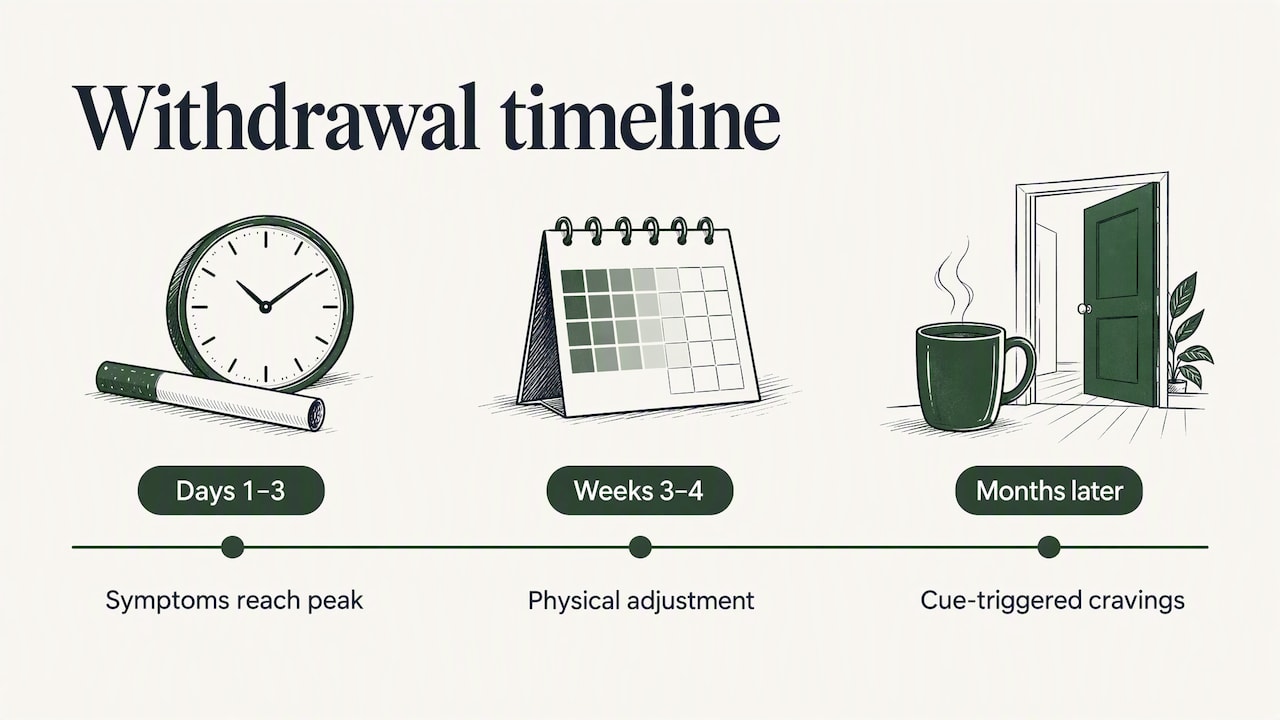
Another myth worth retiring: that a craving months into a quit attempt means something has gone wrong. It has not. Cue-triggered cravings, the kind sparked by an old smoking spot, a familiar drink, or a stressful moment, can surface long after the physical dependence is gone, and that is a normal feature of how memory works, not a sign of failure.
Be skeptical of anything promising a symptom-free quit or a guaranteed timeline. Individual variation is real: how long you smoked, how heavily, your stress levels, and your support system all shape your particular path. What stays consistent is the general pattern, sharp onset, early peak, gradual decline, with occasional later waves, and knowing that pattern in advance is the best protection against mistaking a normal setback for a reason to give up.
How ritual replacement can support your withdrawal process
At Nature of Spirit, we focus on nicotine-free hemp and herbal blends built for people navigating exactly this stretch of early withdrawal. One detail that gets overlooked in a lot of withdrawal advice: smoking is not just a chemical habit, it is a physical ritual, the pause, the hand-to-mouth motion, the inhale and exhale. That ritual does not disappear just because the nicotine does.
Replacing that ritual with something you can still hold, prepare, and draw on, without the nicotine, can lower relapse risk as a behavioral tactic, giving your hands and your routine something familiar while your brain adjusts underneath. This sits alongside NRT and counseling rather than replacing either.
If you want to read further on how this fits into a broader quit plan, our CBD bei Nikotinentzug guide walks through the evidence on CBD during withdrawal, and our rauchen aufhören overview covers therapy, nicotine replacement, and nicotine-free substitutes side by side.
Our take on the quitting advice you’ll find everywhere
Most advice about nicotine withdrawal treats it like a single hurdle: survive the first week and you are done. That framing sets people up to misread a craving in month two as a failure rather than what it actually is, a cue doing exactly what cues do.
What gets underrated is the behavioral side of quitting. Pharmacotherapy addresses the chemistry well, but the hand-to-mouth ritual, the pause in your day, the thing you reach for during a stressful call, rarely gets a real replacement plan. That gap is where a lot of relapses happen, not because the nicotine craving itself was unbearable, but because the habit around it had nowhere to go.
If you take one thing from this: plan for the ritual, not just the chemistry. Decide now what your hands will do during a craving, what you will hold, what you will reach for, before you are standing in a stressful moment improvising.
— Adam
A nicotine-free way to keep the ritual going
We built our Infusedline and Natureline blends for exactly the moment described above: the pause you still want, without the nicotine behind it. Both lines are nicotine-free hemp and herbal mixes, lab-tested, and free from tar and artificial additives, made for people who want to keep the hand-to-mouth ritual of smoking while stepping away from nicotine itself.
These blends are a behavioral ritual alternative, not a medical therapy, and they work best alongside the coping tools covered above rather than instead of them. If you are using NRT or a prescription medication, check with your clinician before adding any new product to your routine.
- Infusedline: a CBD-infused hemp and herbal blend designed for a mild, aromatic smoking ritual
- Natureline: a herbal blend built around the same tar-free, additive-free standard
You can browse the full range on our Infusedline and Natureline product pages, or see how the blends fit into a broader quit plan on our Rauchrituale ohne Nikotin guide.
This article is general information, not a substitute for advice from a qualified doctor. Consult a qualified healthcare professional about your own circumstances before acting on anything here.
FAQ
What is the best way to quit vaping?
The same core approach that works for cigarettes applies to vaping: combining behavioral support with recommended pharmacological treatment like NRT or prescription medication gives better odds than willpower alone. Pairing that with a replacement ritual for the hand-to-mouth habit, and tracking your personal craving triggers, tends to make the first few weeks more manageable.
What are the common psychological effects of nicotine withdrawal?
Irritability, anxiety, low mood, and difficulty concentrating are the most common psychological effects, typically strongest early on and easing over time. Cue-triggered cravings can resurface months later and are a normal part of how associative memory works, not a sign that something has gone wrong.
Where can I get a free quit-smoking kit delivered by mail?
Many national health services and public health programs offer free quit kits or structured support by mail or phone. Your doctor, local pharmacy, or national quitline is the fastest way to find out what is available in your country.
What are the common symptoms of snus withdrawal?
Snus withdrawal involves the same nicotine-driven symptoms as smoking or vaping withdrawal: cravings, irritability, anxiety, sleep disruption, and increased appetite, since the dependence is on the nicotine itself rather than the delivery method. The general timeline follows the same pattern described above, with symptoms starting within a few hours and peaking during the first 3 days.
How long do nicotine cravings last after quitting?
Most physical withdrawal symptoms ease within 2 to 4 weeks, but occasional cue-triggered cravings can appear for months afterward. These later cravings are typically brief, triggered by a specific situation, and pass within minutes if you ride them out.
Sources
- Tips for Coping with Nicotine Withdrawal and Triggers – NCI
- Managing nicotine withdrawal symptoms – Better Health – NHS
- Who
- 7 Common Withdrawal Symptoms | Quit Smoking | Tips From Former Smokers | CDC